













The short answer: any potentially hazardous food in your cool room needs to be at 5 °C or below, and anything in a freezer room needs to stay frozen solid. The longer answer covers where you measure, how you record it and how far you can trust the display on the wall. Sam Celesti has spent more than 20 years servicing commercial cool rooms, and this guide pulls together the official food safety guidance with what he sees on site.
This is general guidance, not legal advice. Food safety obligations depend on your business type and your food safety plan. In Western Australia your local council's environmental health officers enforce the rules, so check with them if you are unsure what applies to you.
What temperature should a cool room be?
Standard 3.2.2 of the Food Standards Code defines "temperature control" as keeping food at 5 °C or below, at 60 °C or above, or at another temperature the business can prove is safe. Potentially hazardous food is anything that needs that control to stop harmful bacteria growing: meat, seafood, dairy, cooked rice and pasta, prepared salads and similar items. FSANZ's Safe Food Australia guide says this food must be stored at 5 °C or below.
Notice that the rule is about the food, not the room. A cool room is usually set a few degrees under 5 °C so the product stays compliant when the door is opened at a busy service, when a warm delivery goes in, or when the system runs a defrost. Where in that range you sit depends on what you store, because produce, beverages and fresh meat each behave differently.
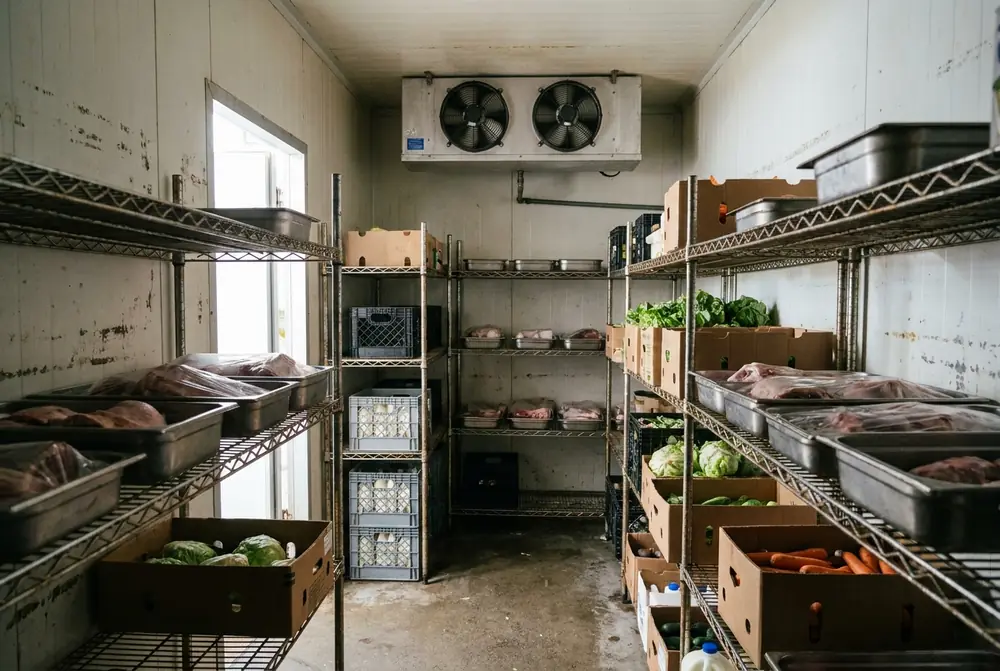
Freezer rooms are simpler on paper and harder in practice. The Code says frozen food must remain frozen, and it defines frozen as not including food that is partly thawed. Safe Food Australia states plainly that no temperature for frozen storage has been specified, and points businesses to the storage conditions on the product label. If you see soft edges on cartons or frost building inside packs, the room is not doing its job.
Cool room and freezer temperature reference table
| What | Requirement or guidance | Source |
|---|---|---|
| Chilled potentially hazardous food | 5 °C or below | Standard 3.2.2, Safe Food Australia |
| Frozen food | Kept frozen hard; partly thawed is not frozen. No number set in the Code; follow the label | Safe Food Australia |
| Hot held food | 60 °C or above | Standard 3.2.2 |
| Temperature danger zone | Between 5 °C and 60 °C | FSANZ 2 hour / 4 hour rule |
| Time out of control | Under 2 hours: use, sell or refrigerate. 2 to 4 hours: use or sell, do not refrigerate again. Over 4 hours: throw out | FSANZ 2 hour / 4 hour rule |
| Cooling cooked food | 60 °C to 21 °C within 2 hours, then 21 °C to 5 °C within a further 4 hours | Standard 3.2.2 |
| Chilled deliveries | Accepted at 5 °C or below (or 60 °C or above for hot food); frozen deliveries accepted only if frozen hard | Standard 3.2.2, Safe Food Australia |
| Thermometer | On site, easy to reach, accurate to +/- 1 °C | Standard 3.2.2 clause 22 |
Product temperature is what counts
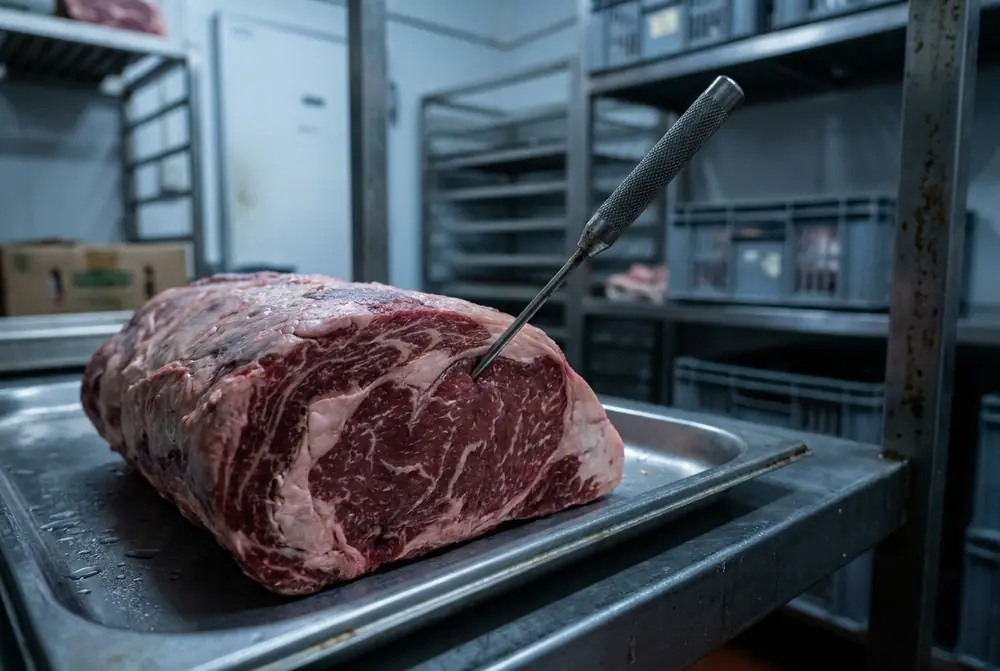
The controller on your cool room reads the air at one sensor, usually near the evaporator. Air warms and cools quickly, while a full carton of milk or a tray of meat changes slowly. That means the display can show 2 °C while stock near the door sits at 6 °C, or it can spike during a delivery while the food barely moves. FSANZ advises checking the food itself with a thermometer rather than relying on the refrigerator's gauge.
To get a reading that means something:
- Probe the thickest part. FSANZ recommends inserting the probe into the thickest part of the food.
- Pick the warm spots. Test items closest to the door, on the top shelves and in any corner where airflow is blocked, not just the product sitting under the fan.
- Packaged goods. Lay the probe lengthwise along the pack, or between two packs, so you are not piercing sealed product.
- Infrared guns. Useful for a fast scan, but they only read the surface, so confirm any doubtful result with a probe.
- Clean the probe. Wash, sanitise and dry it between raw and ready to eat food.
How to keep a cool room temperature log
A log turns a feeling that the room is fine into evidence. Safe Food Australia notes that recording food temperatures helps a business show that potentially hazardous food stays under temperature control. Some food service businesses, including caterers, must substantiate their temperature controls under Standard 3.2.2A, so check which category you fall into.
Each entry should capture:
- Date and time of the check.
- The controller display reading.
- The probe reading and which product you tested.
- Initials of the person who checked.
- Any corrective action taken if a reading was over 5 °C, such as moving stock, discarding it or calling a technician.
How often you check should come from your food safety plan or your council. A reading at opening and another before close is a sensible baseline for most kitchens, because it catches a room that has crept up overnight and a room struggling after a long service. Safe Food Australia includes log templates in Appendix 8. Pair the log with our weekly and monthly refrigeration checklist so door seals, curtains and drains get looked at too.
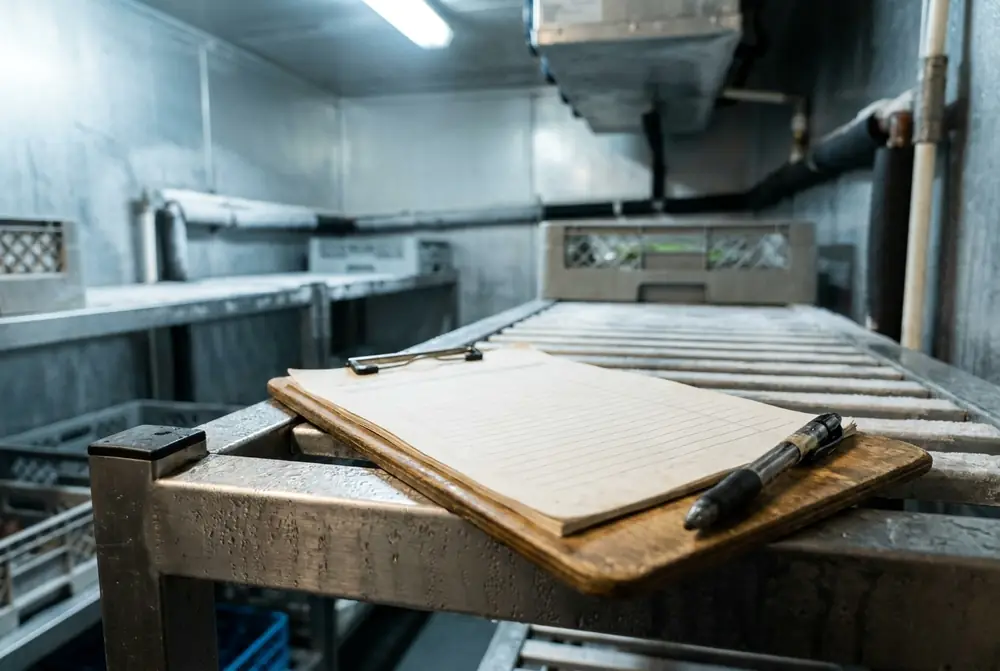
Some sites go further and fit a monitoring device that records continuously and alarms when the room goes out of range. Safe Food Australia mentions these as an option. They are useful in rooms that sit unattended overnight, but someone still needs to probe product and sign the book.
Checking your thermometer is accurate
Clause 22 of Standard 3.2.2 requires the thermometer to measure potentially hazardous food to within plus or minus 1 °C. In practice, a reading of 5 °C means the food is somewhere between 4 °C and 6 °C. Thermometers drift over time and after being dropped, so FSANZ suggests calibrating at least once every 12 months, ideally through the supplier or an accredited laboratory.
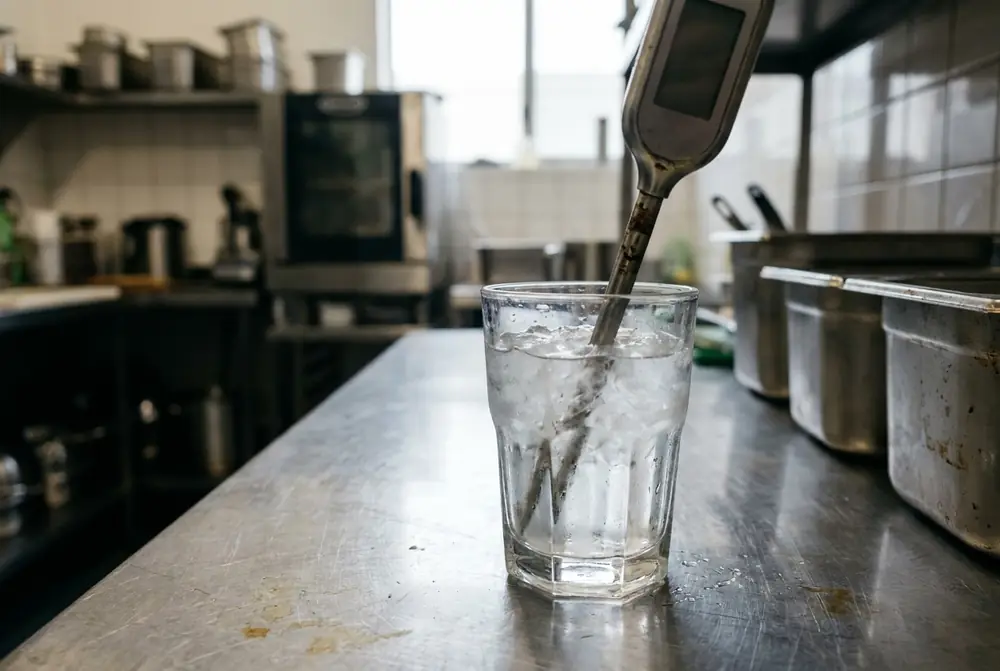
Between calibrations, the City of Cockburn's public health service describes a simple ice and boiling water check:
- Fill a glass with wet ice and cold water.
- Put the probe in the centre of the mixture and stir it around regularly.
- Let the reading settle for about three minutes. It should show 0 °C.
- Repeat in boiling water with at least 7 cm of the probe submerged. It should show close to 100 °C.
- Record the results and initial them so everyone knows when it was last checked.
If the reading is off, try a fresh battery first. FSANZ suggests noting how far out the thermometer reads and the date, and replacing it or having it professionally adjusted if the error is more than 1 °C.
Setpoints, differential and defrost in plain terms
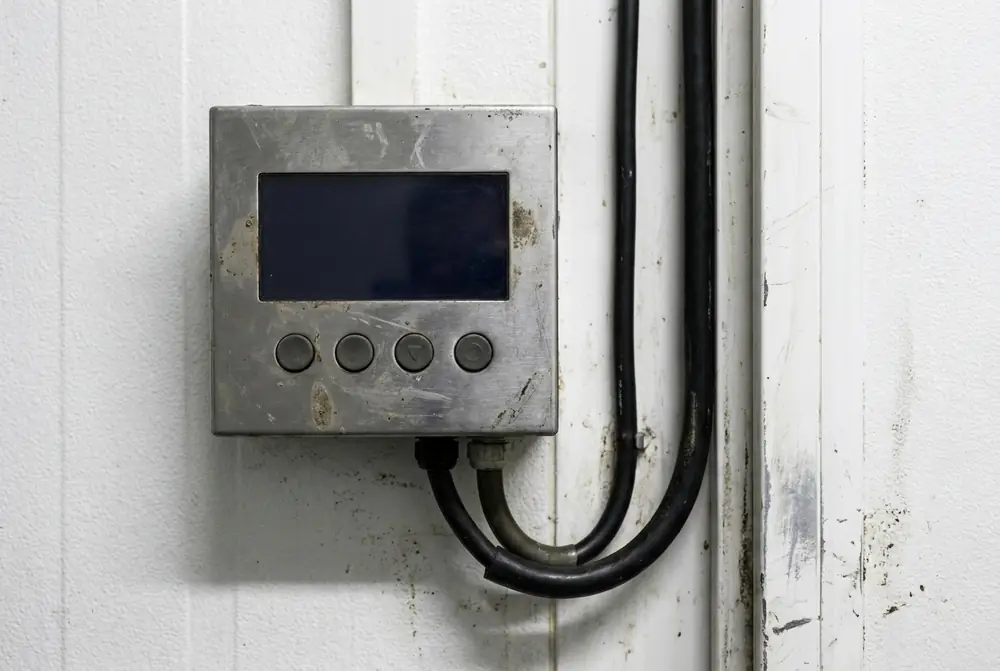
The setpoint is the temperature you ask the controller to hold. The differential is the band around it: the compressor stops when the air reaches the bottom of the band and starts again when it warms to the top. That is why the display wanders up and down by a degree or so during normal running.
Every chilled cool room also builds frost on its evaporator coil, and freezer rooms build it much faster. A defrost cycle pauses the cooling and melts that frost, either by running the fans with the compressor off or by switching on heaters. The air reading rises for a while, then falls once the cycle ends. Stock barely notices, which is another reason to judge compliance by probing product.
Controllers and their sensors can drift. If your probe readings and the display disagree by more than a degree or two, ask for the sensor to be checked against a reference thermometer. That check is part of our scheduled refrigeration maintenance, along with coil cleaning and defrost settings matched to how often your door opens.
What to do when the room drifts above 5 °C
One high air reading during a delivery is not an emergency. A probe reading over 5 °C, or a display that keeps climbing, needs action. Work through these steps:
- Probe several products in different spots and write the readings and the time in your log.
- Check the door. Make sure it closes and seals fully, the strip curtain is in place and nothing is propping it open.
- Look at the evaporator. A coil packed with ice, or fans that are not spinning, will stop the room cooling.
- Check the condenser outside. Clear boxes, rubbish or leaves blocking the airflow around it.
- Reduce the load. An overstocked room cannot move air around the stock. Do not push in large amounts of warm product until it recovers.
- Apply the 2 hour / 4 hour rule to anything that has been above 5 °C, and record what you kept, used or discarded.
If the room does not come back down within a reasonable time, book a cool room repair. Sam offers same-day emergency callouts across Perth, 7 days, and gives a fixed quote before any work starts. For restaurants, cafes and bars with a service coming up, mention that when you call so the job can be prioritised. Rooms that keep drifting after repeated repairs may be near the end of their life; our guide on whether to repair or replace an ageing cool room explains how to weigh it up.